


Shared Service Centers in 2026 Proving Value Under Pressure

For two decades, shared service centers have been measured by efficiency. Costs were reduced. Processes standardized. Work centralized. That model is now being questioned. In 2026, SSCs are being judged on proof – whether they deserve to exist in their current form. The model hasn’t failed. But the expectations around it have changed. Boards are asking, “what does our SSC contribute?” What’s happening goes beyond operational pressure. SSC value is being actively reassessed. Efficiency is now expected as standard. What matters is measurable contribution.
Your AP Automation Wake-Up Call
Calculating the Cost of Doing Nothing [2026 Edition].
This shift is already playing out in how SSC performance is evaluated, funded, and challenged at board level.
In 2026, leading organizations are managing their shared service centers across five dimensions…
- Economic accountability – ROI that can be proven within a fiscal year
- Scalability – volume growth without linear headcount growth
- Regulatory adaptability – readiness for continuous compliance change
- Data integrity – accuracy, auditability, and trust in automated outputs
- Workforce evolution – shifting talent from processing to oversight and analysis
The difference in performance across these five areas is becoming increasingly visible.
AI must earn its seat at the table
Here’s what’s changed…
A year ago, deploying AI in shared service centers was enough. The pilot was the win. The demo was the deliverable. Leaders could point to a proof-of-concept and call it progress.
That expectation has shifted.
Document automation now answers to one metric – ROI. Boards expect returns within the fiscal year. Not projections. Not roadmaps. Actual, measurable outcomes. Processing times down. Error rates falling. Cost per document halved. And if the technology can’t demonstrate that impact, it comes under scrutiny.
SSC leaders have made the case for AI adoption internally. They’ve championed the tools, sponsored the implementations, and reassured the sceptics. Now they have to show the numbers.
What this means in practice for shared service centers
The organizations getting this right are setting baselines first. Current cycle times, error rates, exception rates, cost per transaction – documented, benchmarked, signed off. Then they’re deploying automation against those baselines and tracking monthly.
Take a look at Fugro. By deploying intelligent document processing across its shared service centers, the company reduced invoice processing time from two minutes to 35 seconds per document. Across 300,000 invoices a year. An operational gain that you can report to your CFO.
The level of improvement materially changes the cost profile of the process.
Actionable takeaways…
- Establish hard baselines before any new AI deployment, including current error rates, cost per document, and average processing time
- Set financial targets tied to business priorities, not technology roadmaps
- Establish a monthly ROI review cadence with CFO visibility – automation that doesn’t show measurable gains within 90 days should be deprioritized
- Review performance monthly, not quarterly, and redirect budget away from tools that fail to deliver
- Ask vendors to demonstrate value within 90 days, not 12 months
Once value is proven, the next pressure point is scale.
Scale without headcount is non-negotiable
The shared services model was built on the premise that consolidation creates efficiency. Handle more, spend less. That premise still holds. But the method for getting there has changed.
Hiring your way through volume growth is no longer viable. The economics don’t work. Talent markets in SSC hubs have tightened. Attrition remains high, especially in roles dominated by repetitive, low-value processing tasks. And the business units waiting for approvals, purchase orders, and invoice clearances don’t want to hear that headcount is the bottleneck.
Organizations adopting AI document processing report significant efficiency gains, with teams shifting effort away from manual data entry toward exception handling and process improvement.
Wolt is a great example. Processing 50,000 invoices a month across 10 countries, with a 60% straight-through processing rate – and with an ambition, in their own words, to “constantly push automation higher, so that we can reassign resources to new countries where we want to launch.”
This is how leading SSCs are now operating – volume scales through automation, not hiring. Automation absorbs volume, while human effort shifts toward exceptions, governance, and expansion. SSCs that don’t make this shift see costs rise and performance fall behind peers.
This is what scalable growth looks like in practice.
The hidden cost of staying still
There’s a particular risk SSC leaders face when scale pressure builds but automation capacity doesn’t keep pace. Teams get stretched. Exceptions pile up. Processing service level agreements slip. The business loses trust in the center’s ability to perform. And once that trust erodes, the calls start coming about whether to re-localize functions or move them to alternative providers.
The hyperautomation market is projected to exceed $270 billion by 2034 – driven by exactly these pressures.
Hyperautomation is one of the trends we predict will land heavily in 2026. If you’d like to read more, take a look at Document automation trends 2026. Download our DAT26 report for more information, along with expert analysis, exclusive survey data, how to meet the trends head on, and the KPIs to prioritize.
Actionable takeaways…
- Map the relationship between volume growth and FTE capacity, and model what happens if volume grows 30% in the next 18 months
- Identify the manual bottlenecks eating most processing time and target those first
- Build automation that learns from your team’s existing corrections – so the system gets smarter over time without ongoing manual rule-writing
- Measure straight-through processing rates monthly and set targets that push incrementally higher each quarter
As operations scale, complexity increases – particularly across regulatory environments.
Compliance complexity is outpacing your tool stack
Imagine running a shared service center across five countries. Different tax rules. Different invoice formats. Different e-invoicing mandates. Different regulatory timelines. Different ERP configurations per region.
Now multiply that by ten countries. Or fifteen.
This is the reality for global SSC operations. And it’s getting worse. New e-invoicing regulations are coming into force across Europe – ViDA in the EU, updated mandates in France, Belgium, and Poland – while similar frameworks are tightening in Latin America, India, and beyond. Enterprises must manage mixed formats – PDF, XML, EDI – across languages, currencies, and compliance rules.
The problem with fragmented tool stacks is this… each tool knows its piece. None of them knows the whole picture. And when a compliance update hits a jurisdiction your current setup wasn’t built for, the disruption begins. Manual intervention. Rushed workarounds. Delays that ripple through supplier relationships and payment cycles.
Compliance failures can cause weeks of disruption and millions in losses. That’s a risk most shared services organizations can’t afford to delay addressing.
What unified platforms solve
Platforms built for global SSC operations handle the complexity that fragmented tools push back onto your team. They translate documents across languages, validate against local regulatory requirements, and adapt as compliance rules change – all within a single workflow. The result is a consistent, automated process that scales across regions without adding operational overhead.
Actionable takeaways…
- Audit your current tool stack against upcoming e-invoicing mandates and identify where manual intervention will be required if nothing changes
- Prioritize platforms that handle multiple formats natively, rather than tools that require format standardization before processing
- Ensure any compliance update in a new jurisdiction can be reflected in your automation without a full implementation project
- Build a compliance calendar for 2026 and 2027 with a clear owner for each regulatory change
As compliance demands grow, so does the need for data you can trust.
Data accuracy is now a board-level risk
This is a relatively new shift.
Data quality in shared service centers was an operational concern. A processing metric. Something the team managed internally, measured in error rates, logged in exception queues.
Improving data accuracy is now the number one priority for 61.6% of finance leaders surveyed in Rossum’s Document automation trends 2026 report, based on a survey of 450 finance leaders across the UK, US, and Germany.
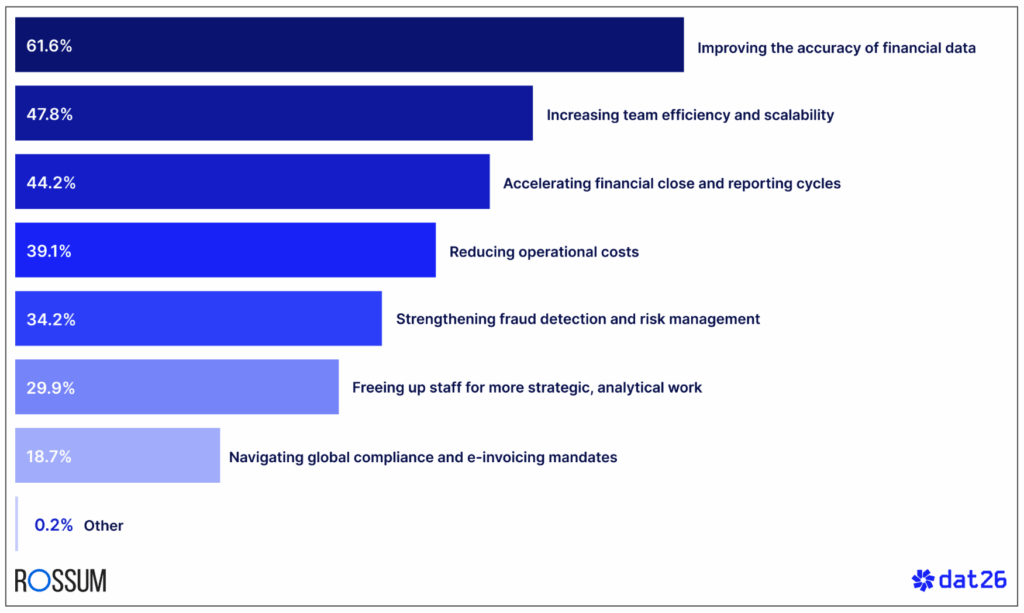
What are the primary business objectives driving your finance automation strategy?
That’s a board-level concern now. And it makes sense. At scale, data errors don’t stay contained – they translate directly into financial and reporting risk. When automation touches accounts payable at scale, a systemic error can move into your ERP, affecting supplier ledgers, distorting financial reporting, and creating audit exposure at leadership level.
Blackbox AI introduces risks that are difficult to audit and explain. Systems managing invoices, purchase orders, or personal records must prove reliability through bias testing, privacy audits, and explainability – because one unexplained error can destroy years of trust.
Rather than treat AI governance as a constraint, organizations getting ahead of this are treating it as infrastructure. Clear roles, documented responsibilities, auditable decision trails. Allowing the program to scale with confidence.
Fraud is part of the accuracy buzz
Traditional fraud detection reacts after money disappears. AI turns that model around – spotting anomalies early, flagging unusual patterns, and acting fast. Duplicate invoices, suspicious supplier requests, fake invoices, totals outside expected ranges – these are caught before they clear, not after they’ve cost you.
The US Treasury’s AI systems provide a critical signal here. In FY2024, those systems prevented and recovered over $4 billion in improper payments. Enterprise SSCs managing high invoice volumes and diverse supplier bases face the same exposure at a smaller scale – but the principle holds.
Actionable takeaways…
- Implement confidence scores and audit trails for every automated extraction decision – so you can explain any output if challenged
- Build exception queues that catch anomalies before data reaches your ERP, not after
- Assign clear AI governance ownership within the SSC, with a defined review cadence
- Set up automated checks for duplicate vendors, unusual payment patterns, and invoice totals outside historical norms
Meeting these expectations requires different capabilities within the SSC.
Your operating model is outgrowing your talent
The final challenge is less discussed, but increasingly important.
Strategic financial planning and analysis is the number one skill that finance teams say they need most right now – cited by 29.8% of respondents in Rossum’s 2025 automation statistics survey. And yet the people currently sitting in SSC processing roles are still largely hired and trained for data entry, exception handling, and rule-following. Skills that automation is absorbing.
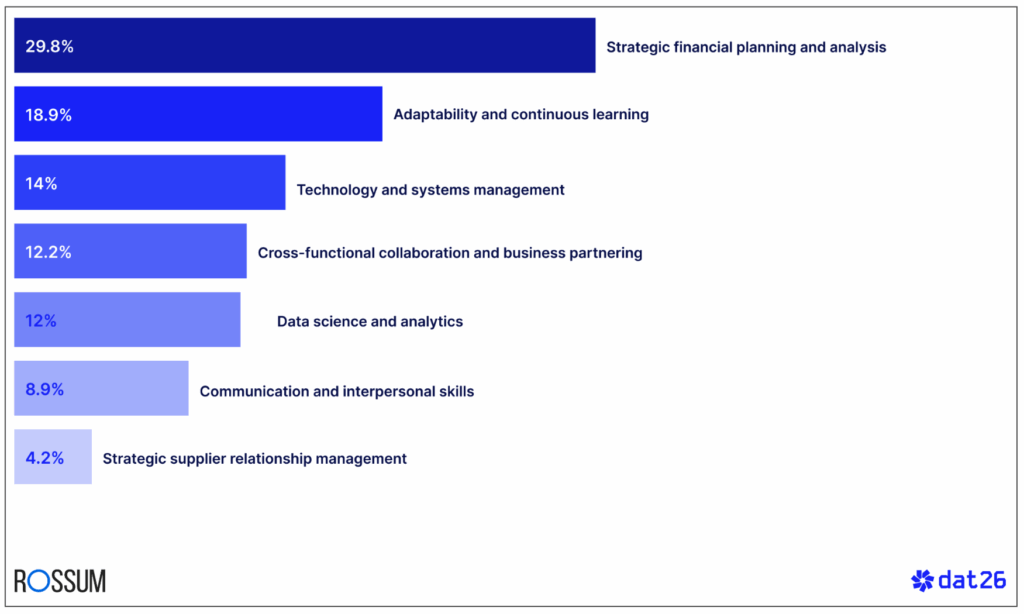
As automation handles more routine financial tasks, what becomes the most important skill for your finance team members?
This creates the gap. The center needs people who can supervise AI systems, interpret exception patterns, manage vendor relationships, and contribute to process governance. The talent it has was built for a different kind of work.
This is a workforce planning issue and the SSCs that solve it fastest will be the ones that treat automation as a talent development program, not a headcount reduction exercise.
The retention dimension
There’s a parallel issue. The people doing the most repetitive processing work are often the first to leave when a better opportunity appears. And the cost of that attrition – recruitment, training, the accumulated institutional knowledge that walks out the door – rarely appears in the calculation when SSC leaders are making the case for automation investment.
Removing repetitive, low-value tasks must be part of your retention strategy. People who spend their days on meaningful exception-handling, supplier communication, and process improvement are more likely to stay. And the SSC benefits from the institutional knowledge they build along the way.
Actionable takeaways…
- Map your current team’s skills against the roles you’ll need in 18 months, post-automation
- Create structured upskilling pathways for team members moving out of high-volume processing roles
- Involve processing teams in automation strategy – they understand the edge cases better than any implementation consultant
- Measure attrition in SSC processing roles and factor it into the real cost of staying manual
This is where execution separates leading SSCs from the rest.
The 90-day SSC reset
For SSC leaders, the priority is focus. Broad transformation efforts often stall without a clear starting point.
- Choose one high-volume, high-cost process – typically AP
- Establish baseline metrics within 30 days – cost, cycle time, error rate
- Deploy automation with a clear 90-day ROI expectation
- Assign single-thread ownership for AI performance and governance
- Track one KPI that matters at board level – e.g., cost per invoice
Momentum comes from proving value quickly, not transforming everything at once.
These five challenges are the operational realities SSC leaders are navigating right now. Volume pressure. Compliance complexity. AI accountability. Data integrity. Skills transition.
What makes 2026 different from previous years is the stakes. There’s no grace period for getting automation right. The cost of standing still is visible in headcount budgets, SLA misses, compliance exposure, and talent pipelines that are thinning out.
The SSCs making tangible progress are focusing on a few fundamentals. They’re setting hard baselines, choosing platforms over point solutions, governing their AI seriously, and investing in their people as the work around those people changes.
Veolia achieved 90% automation in its shared service center using intelligent document processing, resulting in document processing speeds eight times faster than before. Morton Salt saves up to 95% of time spent per document, with a 71% straight-through processing rate. Fugro onboarded four SSCs in three months.
These are early indicators of where the operating model is going.
If these challenges sound familiar, the starting point is to take a brutally honest look at where your automation maturity sits.
Rossum’s AP Automation Maturity Quiz takes less than five minutes and gives you a clear picture of where your shared service center stands relative to the benchmarks that matter in 2026.
Or, if you’d rather see what an AI document processing platform looks like inside a real SSC environment, book a free demo with the Rossum team. A working platform designed for the complexity SSCs operate within.
The SSCs that get this right won’t announce it. You’ll see it in their processing times, their audit trails, and the fact that their teams are working on problems worth solving.