


E-invoicing France 2026 and The Cost of Waiting

On February 2, 2026, the French government formally adopted the 2026 Finance Bill (PLF 2026), having officially cleared the final legal hurdles for its new tax system. This law makes the upcoming continuous transaction controls (CTC) for B2B e-invoicing France mandate (Facturation Électronique) and e-reporting legally effective.
The transition begins on September 1, 2026. This shift is not a suggestion. It is a strict legal requirement that will fundamentally change how your Accounts Payable (AP) team handles every transaction.
Get a step-by-step checklist to navigate the 2026 e-invoicing France mandate.
The 2026 mandate and your responsibility
The 2026 Finance Bill confirms a phased rollout, but the initial date applies to everyone. By September 1, 2026, every VAT-registered company in France must be able to receive electronic invoices. Large and mid-sized companies must also begin issuing them and start e-reporting for B2C and international transactions. By September 1, 2027, the issuing mandate extends to all small and medium enterprises.
Missing these dates carries immediate and damaging financial consequences. The new law significantly increases the penalty regime to enforce compliance:
- Platform negligence: Taxpayers failing to use an approved platform to receive e-invoices face penalties. While a three-month correction period is granted if no contract is in place, the risk of payment delays and blocked workflows remains high.
- E-invoicing violations: The fine has increased from 15 € to 50 € for every non-compliant invoice, capped at 15,000 € per calendar year.
- E-reporting failures: Non-compliance carries a fine of 500 € per transmission, also capped at 15,000 EUR per year.
Strategic hurdles AP teams have to face
The transition involves more than just a new file format. The 2026 Finance Bill introduces technical infrastructure that requires high levels of data accuracy. Many teams realize too late that their internal data is not ready for the rigors of the French “Y-model” system.
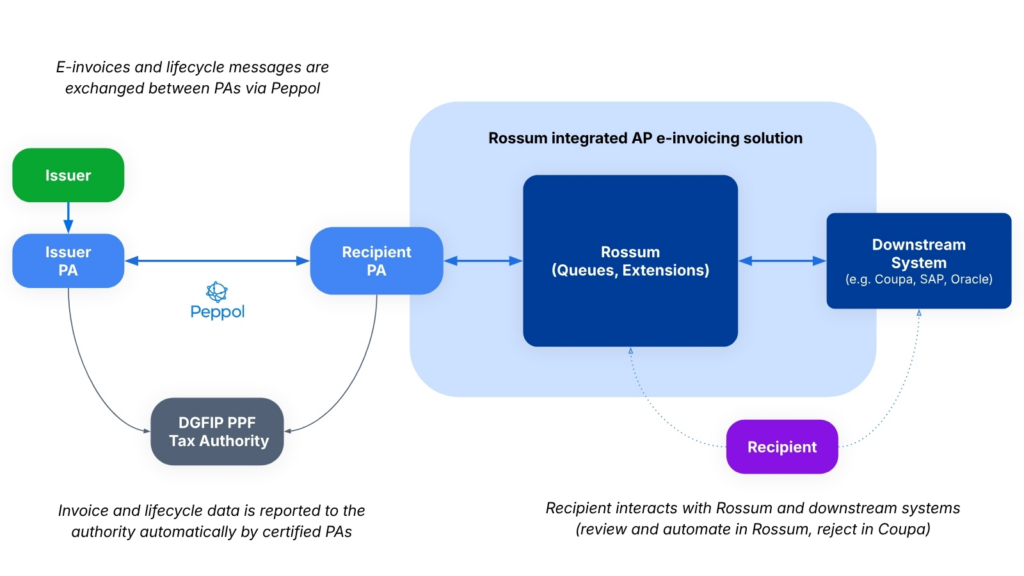
A central directory accessible through the Public Invoicing Portal (PPF) is now officially established. This directory ensures that e-invoices are routed correctly to the recipient’s platform. For this to work, your internal data must be perfect. If your vendor SIRET (a unique 14-digit identifier for business establishments in France, assigned by the French National Institute of Statistics and Economic Studies (INSEE) to track geographic location) or SIREN (a unique 9-digit identifier issued by INSEE to identify a specific legal entity or company in France) numbers are outdated, the central directory cannot route the invoice, leading to immediate rejection.
Another issue is the variety of formats. The e-invoicing France mandate supports Factur-X, which is a PDF with an XML file inside. Standard tools often struggle to process these hybrid files alongside international PDFs or Peppol streams. AP teams may end up with fragmented workflows, using different tools for different regions, which creates data silos and increases the risk of error.
Reporting obligations have also been refined. Payment status reporting is now mandatory for all operations where VAT becomes due upon collection. The new law requires you to report the status of an invoice, such as when it is received, rejected, or paid. This broadens the reporting workload for businesses, requiring AP teams to track and transmit the “refusée” (rejected) status of invoices.
Another hurdle is the terminology and certification shift. The government now uses the term Plateforme Agréée (PA) to replace the previous PDP designation. Your AP team must ensure they are working with a provider that aligns with PA requirements to avoid the new penalties associated with improper receiving methods.
Consolidating your global AP strategy with Rossum
Rossum provides a unified AI document processing platform to manage this entire transition. Instead of juggling multiple tools for different regions, you can process French Factur-X files, standard PDFs, and electronic streams in one interface.
This unified approach is essential for companies managing complex global requirements, where Rossum’s e-invoicing solution streamlines compliance across various e-invoicing standards. By centralizing these diverse data streams, your AP team can maintain a consistent workflow regardless of local tax mandates in Poland, Italy, or beyond.
See how Rossum processes e-invoices in action
Our platform uses AI to validate incoming data against the e-invoicing France regulatory requirements. It checks and matches mandatory fields like VAT numbers and SIRET codes to your ERP records before they reach the government portal. This validation helps you avoid the 50 EUR per-invoice fines.
The 2026 mandate extends e-reporting to cross-border invoices, requiring real-time data transmission. Rossum provides built-in support for these expanded obligations, keeping your global AP operations compliant by default. The new standards also broaden the reporting workload for businesses by requiring AP teams to track and transmit the refusée (rejected) status. A refusée status is sent via Rossum when an e-invoice is rejected for a business reason, such as a price mismatch. These rejections can be managed directly in Rossum or synced from a downstream system like Coupa or SAP to ensure your mandatory reporting remains accurate.
As the September 2026 deadline approaches, the demand for approved platforms will increase, and implementation timelines will tighten. Starting your transition now gives you the time to clean your data and integrate your systems without the pressure of an imminent deadline. Book a demo with our team to begin preparing your AP operations for the new e-invoicing France standards.
Frequently Asked Questions
Yes. To support diverse teams, the Rossum interface can be localized into French for local specialists. More importantly, Rossum includes a document translation feature that can translate French invoices into English or other languages. This is a critical tool for global shared service centers (SSCs). It allows non-French speakers to accurately validate and manage information captured from French documents while maintaining a unified global AP strategy.
Rossum acts as a centralized AI hub that connects your AP operations directly to the French e-invoicing ecosystem. We partner with certified Plateformes Agréées (PA) to provide a seamless, end-to-end 5-corner model exchange. This allows you to benefit from Rossum’s superior AI data capture while ensuring every invoice is transmitted and reported in full compliance with DGFiP standards.
Rossum natively supports Factur-X, the hybrid format mandated by the French tax authorities. Because Factur-X contains both a human-readable PDF and a machine-readable XML layer, our AI is specifically configured to prioritize the XML file as the primary source for data capture. This ensures 100% accuracy in the structured data transmitted to the government portal. Simultaneously, the platform presents the PDF as the legal and visual representation for your AP team to review.
Yes. While the French mandate requires e-reporting at least every 10 days for most companies, Rossum’s capability goes further by supporting daily reporting for all B2B cross-border transactions. This high-frequency automation ensures that data from international suppliers is captured and prepared for transmission immediately, effectively removing the pressure of the 10-day regulatory window. Unlike domestic B2B transactions which are reported in real-time by the Plateforme Agréée (PA), international invoices require this proactive e-reporting logic to maintain full compliance.
Rossum captures and matches SIRET and SIREN identifiers directly against your internal master data. Beyond these national IDs, Rossum can validate any custom field (such as internal vendor codes) to ensure your data is perfectly synchronized with your ERP before it reaches the government portal.